
Profile in Compassion: Jim Broderick

Updated: Mar 24
We feature a ‘Profile in Compassion’ to highlight the knowledge, leadership, and lived experience within firewood banks. These stories remind us that the strength of this movement comes directly from the people who build and sustain it. This month we feature Jim Broderick, a logger from Colorado that is a trusted wood source for many southwest tribal firewood distribution programs. Feel free to suggest the next one!

Occupation and Relation to the Firewood Community
Jim Broderick, from Triple J Logging, is a multifaceted, hard-working guy. He held a career in hydrovac, where he managed 29 stations across the US before transitioning to logging about ten years ago. After his wife had a life-altering medical event, he had to spend less time at work, and self-employment was the way to go.
He has always been a farmer and rancher of a small herd of Highlander cows, mini Herefords, and one Jersey dairy cow, Daisy. He also keeps bees and stewards a fruit orchard. Jim became a log hauler because he had experience in trucking from working in the oil field and was able to make the initial investment in equipment.

Organizing people is his strong suit, he’s always enjoyed improving complex systems and he found logging gave him that outlet while contributing to an industry that is so needed in the southwestern United States. The volatility of logging is seasonal so he works hard and fast during open seasons, delivering loads of logs to many tribal communities around the Southwest. Strengthening or coordinating Spring wood deliveries is something he hopes to improve for the Southwest communities he serves.
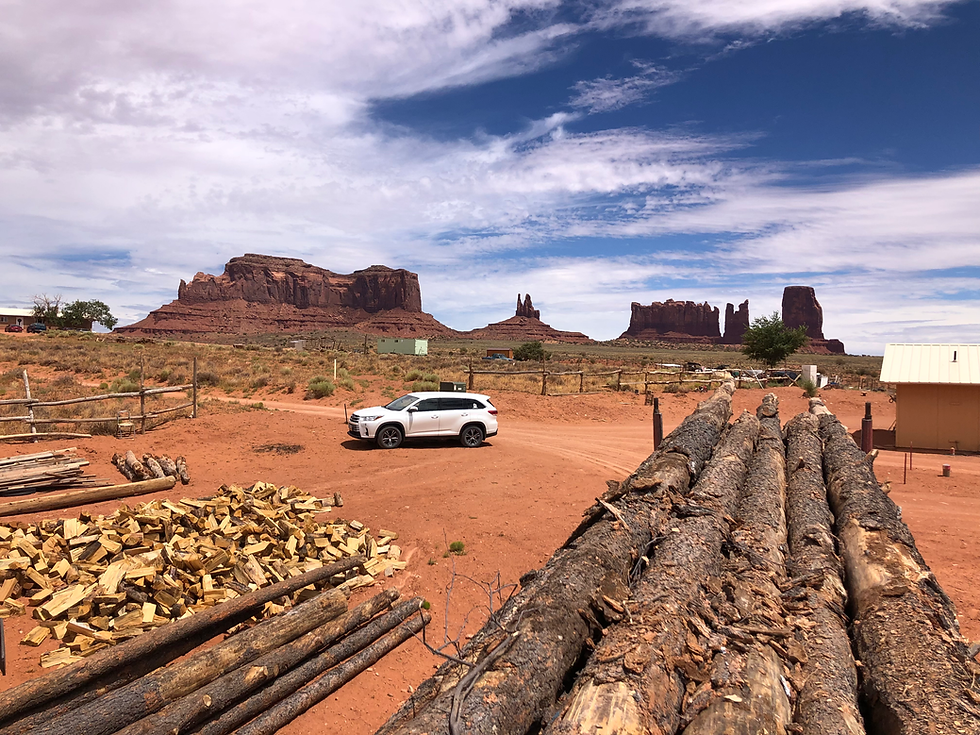
“The view from my office changes everyday and every mile. “
Motivation and Meaning Behind Jim's Work
He noticed a real need for the wood, rather than a want. Tribal members need it for heating, cooking, and ceremonial purposes. He was raised in Canada with a native community of friends and understood the culture behind firewood and natural resources. Jim respects native culture, enjoys supplying a critical resource, and really just likes helping people.

Jim likes meeting and seeing the people he delivers to. Talking to clients and witnessing their real appreciation for the work he does keeps him going. He finds the work relaxing and important.
When he first started working with Wood For Life partners and the USDA Forest Service he delivered two loads of logs to the Chinle Chapter he met a jubilant crew of young sawyers with very minimal equipment (chainsaws and mauls) that were just happy to be processing firewood; their enthusiasm for the work was never forgotten.
Trucks from locals lined up around the lot to collect wood was a wonderful example of community, and delighted Jim to see. Assisting in any part, with getting firewood to people who need it, is fulfilling work.
Favorite Story Related to Hauling or Firewood Bank Deliveries
*Laughs* The highlights are frequent. He really enjoys waking up at two or three in the morning, before the sun comes out, to see all of the local wildlife waking up or heading home from their night shift. He regularly sees elk, bobcats, deer, coyotes, and all of nature in the peaceful hours of the morning before taking off for the day.
His most treacherous mountain pass is Red Mtn. He recalled a time when he radioed another hauler for a road report and was told the road was just a little wet. He started sliding on the wet surface which turned to ice and jack-knifed down the highway towards a tunnel. He corrected immediately in the middle of a highway, in just enough time to enter the dry tunnel. It’s drives like this that keep you alert and ready for anything.

Words of Wisdom About Logging
Don’t think that it’s a get-rich-quick scheme, and to stay on top of your business goals and overhead. Starting in this industry is hard enough, so it’s important to stay in business and remain successful.
Jim anticipates large expenses to operate and insure his self-loading log truck. For instance: Eight tires at up to $800/front steer tire is $6,400.00, annual insurance rate is $7,000.00, and each load which uses 60-70 gallons of fuel, on average, used to cost $175/load and today costs $300/load to cover the same distance. His latest solution to the rise in fuel prices is to explain to his clients where the increase comes from and add on a fuel surcharge rather than increase his rates overall.

He tries to keep his deliveries affordable for the communities he serves and can maintain a rate of $2,600.00/load compared to others who have charged $7,000.00/load. Time of year impacts his rate and workload a great deal; hauling logs in the spring is significantly easier than hauling logs in the fall because unexpected forest closures due to wildfire and weather are more likely in the fall.
Never get complacent! Always stay aware and continue learning!
Jim reminds us that logging is one of the most dangerous jobs to enter into. The logging industry falls within the top 10 most dangerous fields. Never get complacent with the work you're doing, he says. Stay aware of how you’re loading logs, moving them around, and don’t get lazy. Recently, a log broke while lifting it onto the truck with the self-loader. The split log came at him and only slightly injured his finger (despite requiring stitches); however, it could always be worse.
Jim works alone in remote areas, out of cell phone service. You have to take care of yourself and use preventative measures to stay safe. Driving the haul truck also takes awareness and patience. Elevation changes and icy roads are common when accessing timber environments, so managing speed and knowing your routes is essential to stay safe on the road.
For young people to get in today, it’s almost $1,000,000 to purchase the required equipment. If the equipment were easier to acquire, it would make entering the industry and gaining experience with a mentor easier.
Favorite Thing to Listen To While Hauling
Old-time rock and roll, bluegrass, and country music are his go-to radio genres. However, a windshield view is all he needs to remain content.


Comments